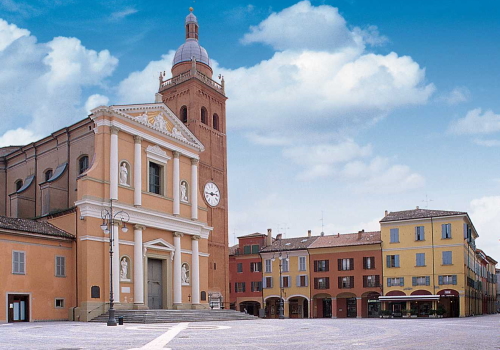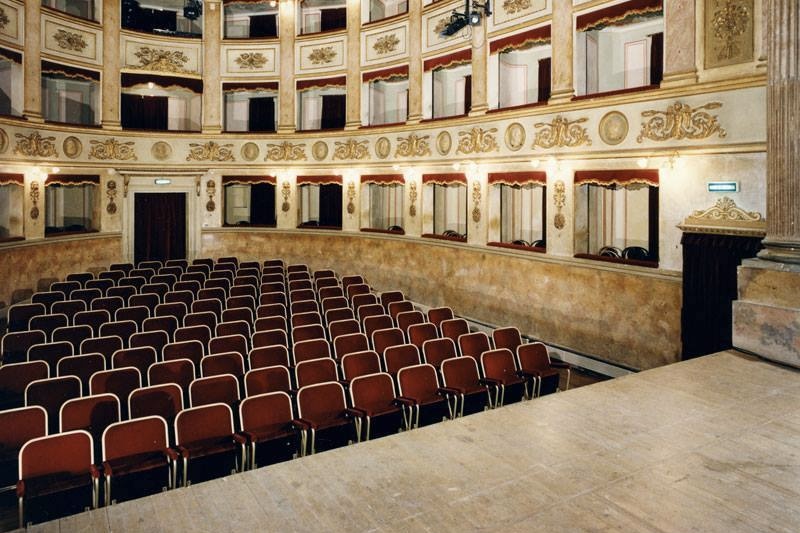
Built in the late 18th century on the site of the previous wooden theatre, this magnificent Italian-style theatre is situated within the Town Hall.
As early as the 18th century, the San Giovanni Theatre enjoyed an excellent reputation, with famous visitors writing about it in their memoirs. Designed by Giuseppe Tubertini, with a U-shaped layout, four tiers of boxes and a splendid proscenium arch, the new brick theatre was inaugurated in 1790 whilst work was still unfinished. It was not until the mid-19th century that it was adorned with stucco work and exquisite ceiling paintings, created by Andrea Pesci and Gaetano Lodi, artists who had also decorated the Municipal Theatre in Bologna. The theatre was used for performances of all kinds, including civic and patriotic celebrations. The open entrance hall beneath the palace’s portico and a tiny tricolour flag painted beneath a box reveal, following the unification of Italy, the theatre’s cultural transition from an aristocratic gathering place to a venue open to all, with the creation of a gallery accessible even to the poorest classes. A series of historical and political upheavals, its use as a cinema – the first in the city – and a fire that broke out beneath the stalls in 1971 led to the theatre’s closure on grounds of unfitness for use. Following the conservation restoration work that began in 1982, it has been restored to its former glory. The orchestra pit has recently been restored to enable a broader programme of musical works and to return the theatre to its original purpose.
A twenty-five-minute train journey from Bologna, eight kilometres from the Bologna-Modena motorway junction, on the Italian section of EuroVelo 7 for those arriving by bike.
San Giovanni in Persiceto station, Bologna–Verona line. Trains run every 30 minutes from Bologna Centrale; the journey takes 25 minutes.
A14 motorway, take the Borgo Panigale or Modena Nord exit, then the SS568. Free car parks near the city centre.
On the Ciclovia del Sole (EuroVelo 7), 25 kilometres from Bologna along the cycle path on the former railway line.
Save the attractions, plan your route, and follow the Cultural Metro lines.