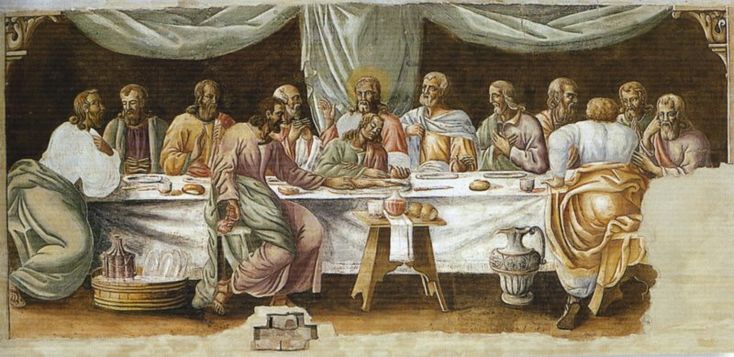
A real surprise came to light in the 1990s in the ancient refectory of San Francesco. Whilst clearing a passageway, the builders stopped short when they came across small coloured fragments standing out amongst the rubble; behind a “ringuscio” wall, a fresco depicting The Last Supper reappeared.
It is a large work, approximately 6 metres long, in the Venetian style, which has not yet been documented in any written sources; Franciscan inscriptions and mottos also appear on either side. In the central section, the apostles surround Jesus as they sit at a simple yet elegant table, covered in linen and laid with white majolica plates, with bread and wine; on the floor, next to Judas, stands a curious tub filled with water for washing the dishes. A key factor in dating the fresco to the late 16th century was the elegant and refined jug in the foreground, on which, alongside the Franciscan symbols, a coat of arms featuring a winged dragon with claws on its legs is depicted. Research traces this heraldic emblem to the Borghese family, specifically to Cardinal Camillo Borghese, the future Pope Paul V, who served as vice-legate in Bologna between 1588 and 1591.
A twenty-five-minute train journey from Bologna, eight kilometres from the Bologna-Modena motorway junction, on the Italian section of EuroVelo 7 for those arriving by bike.
San Giovanni in Persiceto station, Bologna–Verona line. Trains run every 30 minutes from Bologna Centrale; the journey takes 25 minutes.
A14 motorway, take the Borgo Panigale or Modena Nord exit, then the SS568. Free car parks near the city centre.
On the Ciclovia del Sole (EuroVelo 7), 25 kilometres from Bologna along the cycle path on the former railway line.
Save the attractions, plan your route, and follow the Cultural Metro lines.